- Crazy Pablo
- Posts
- Crazy Pablo: Spiritual Spiral Jetty
Crazy Pablo: Spiritual Spiral Jetty
This week, we’re leaving white cubes and the museum walls behind and stepping into something wilder: the place where art meets nature, and the spiritual becomes physical.

Inbal Zakai
December 21, 2025
First time reading? Sign up here.

By Sculpture: Robert Smithson 1938-1973Image:
Soren.harward at en.wikipedia - Transferred from en.wikipedia to Commons.,
Public Domain, https://commons.wikimedia.org/w/index.php?curid=2155549
The Spiral - Earth and Water
Made of basalt rocks, salt, and earth, the spiral curls from the edge of the lake into its pinkish waters. It’s not just a shape, it’s a movement. Inward and outward, like breathing or a meditative walk. It draws you in physically, but also spiritually.
The rough desert ground meets the hypersaline lake in a strange, beautiful tension. Sometimes the jetty disappears under water. Other times, it’s sun-scorched and crusted with salt. Nothing here is fixed. Everything depends on weather, time, and patience.
Smithson’s Spiral Jetty isn’t just a sculpture, it’s a meditation. On time and nature, on our desire to leave a mark that lasts, even when nothing really can. You don’t look at this artwork, you walk it. Feel the salt under your shoes. Breathe in the vast emptiness and Hear the silence. It’s a reminder that we’re part of something much bigger: the land, the cosmos, the spiral of life and decay.
Fun Fact
Spiral Jetty was created in 1970 by American artist Robert Smithson at the northeastern shore of the Great Salt Lake in Utah. It stretches about 1,500 feet (460 meters) into the lake, made from over 6,000 tons of basalt rocks and earth. At times, the sculpture disappears completely under the water - not due to neglect, but by design. Smithson embraced entropy, change, and natural forces as part of the artwork itself.
He never saw it again. A few years after completing the jetty, Smithson died in a plane crash while surveying another land art site.
 By Sculpture: Robert Smithson 1938-1973 - Transferred from en.wikipedia to Commons., Public Domain, https://commons.wikimedia.org/w/index.php?curid=2489862 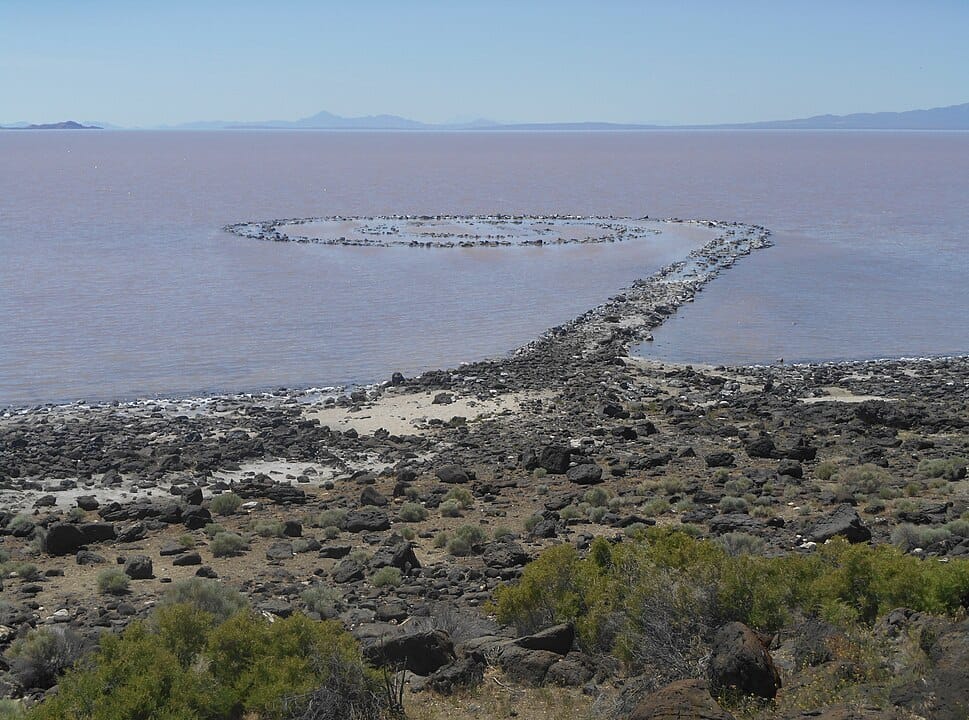 By Ned Hartley - Own work, CC BY-SA 4.0, https://commons.wikimedia.org/w/index.php?curid=150977483 | Think About It 🤔What does it mean to "see" a piece of art you've never stood inside of? Most of us know Spiral Jetty from photographs, but this work was meant to be walked, to be felt with the body. The spiral is more than a shape. In many spiritual traditions, the spiral is a path: inward for reflection, outward for expansion. Birds of prey ride thermal spirals to rise higher into the sky -nature’s own metaphor for transformation. Smithson’s jetty doesn’t just sit in nature; it moves with it, reminding us that the journey up or down, is never linear. |
How does it relate to the here and now? or What to say during casual conversation to show off your art knowledge?
It's Not Just a Spiral, It's a Portal - “Most people have only seen Spiral Jetty on Instagram or in textbooks. But this artwork isn’t meant to be consumed in pixels. In a hyper-digital world, it invites us to reconnect with the Earth, with time, and maybe even with ourselves.”
You Think You Know It - Until You’re There - “We often think we understand something because we’ve seen images of it, read headlines, or scrolled through takes online. But being there changes everything.”
Now have another Look!
By Sculpture: Robert Smithson 1938-1973Image:
Soren.harward at en.wikipedia - Transferred from en.wikipedia to Commons.,
Public Domain, https://commons.wikimedia.org/w/index.php?curid=2155549
And If You’re Up for More…
The Middelheim Open Air Museum in Antwerp invites you to experience art among trees, birds, and shifting weather. It’s a quiet revolution - art that unfolds with time, space, and sunlight.
Smithson's lesser-known spiral in a Dutch quarry. Walk the hill, feel the land shift underfoot. A quiet echo of Spiral Jetty in in Emmen, Netherlands. Walk it, feel it, get lost in the spiral.
Visit the Učka Land Art Trail in Istria, Croatia. A forest trail filled with site-specific sculptures. Nature and art merge with every step.
Till next time, we often see art, but how often do we feel it? Let me know what stayed with you in a reply or a comment.
Yours,
Inbal Z M

Reply