- Crazy Pablo
- Posts
- Crazy Pablo: Luncheon on the Grass
Crazy Pablo: Luncheon on the Grass
What happens when you stand in front of a painting and suddenly realize it’s not telling you what to think—or even what it wants from you?A painting that doesn’t explain itself, doesn’t comfort, and quietly asks you to figure it out.Ready to see how that confusion changed everything?

Inbal Zakai
February 08, 2026
First time reading? Sign up here.
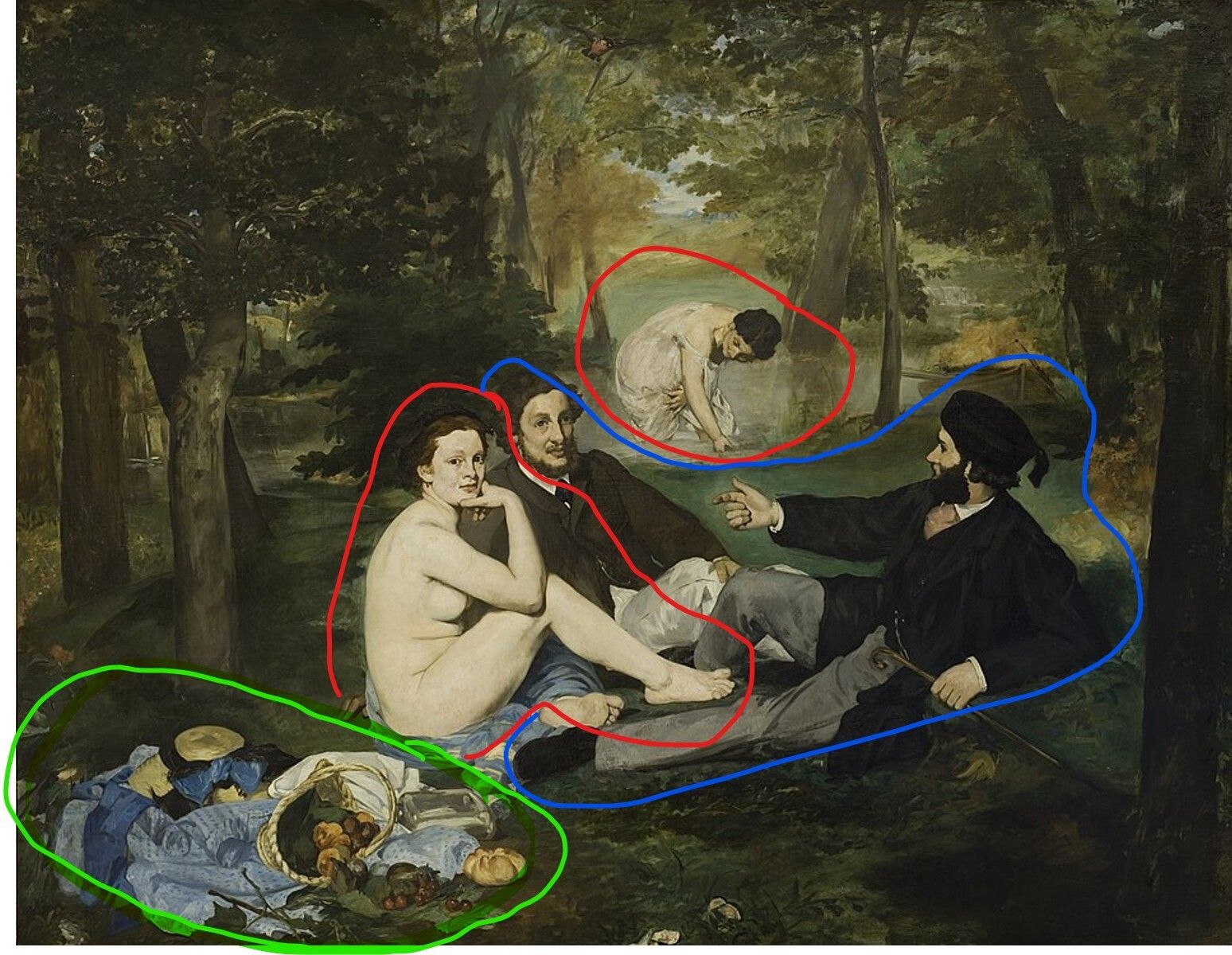
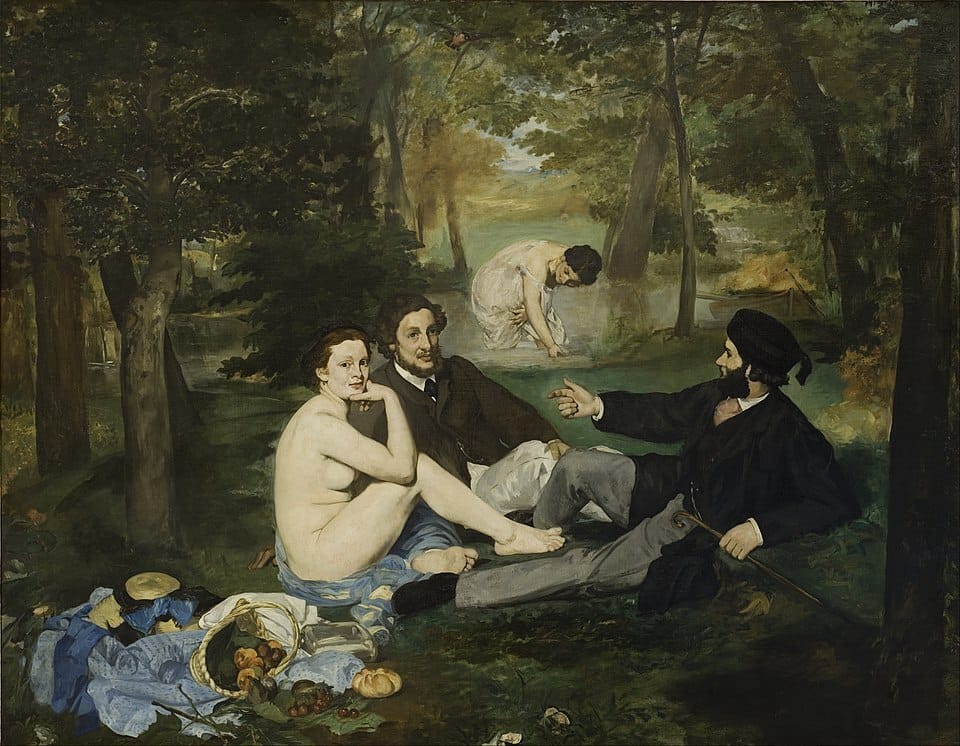
Édouard Manet, Le Déjeuner sur l’herbe (1862–63), oil on canvas, 208 × 264.5 cm, Musée d’Orsay, Paris. twELHYoc3ID_VA at Google Cultural Institute maximum zoom level, Public Domain, https://commons.wikimedia.org/w/index.php?curid=21855901
The two dressed men (marked blue)
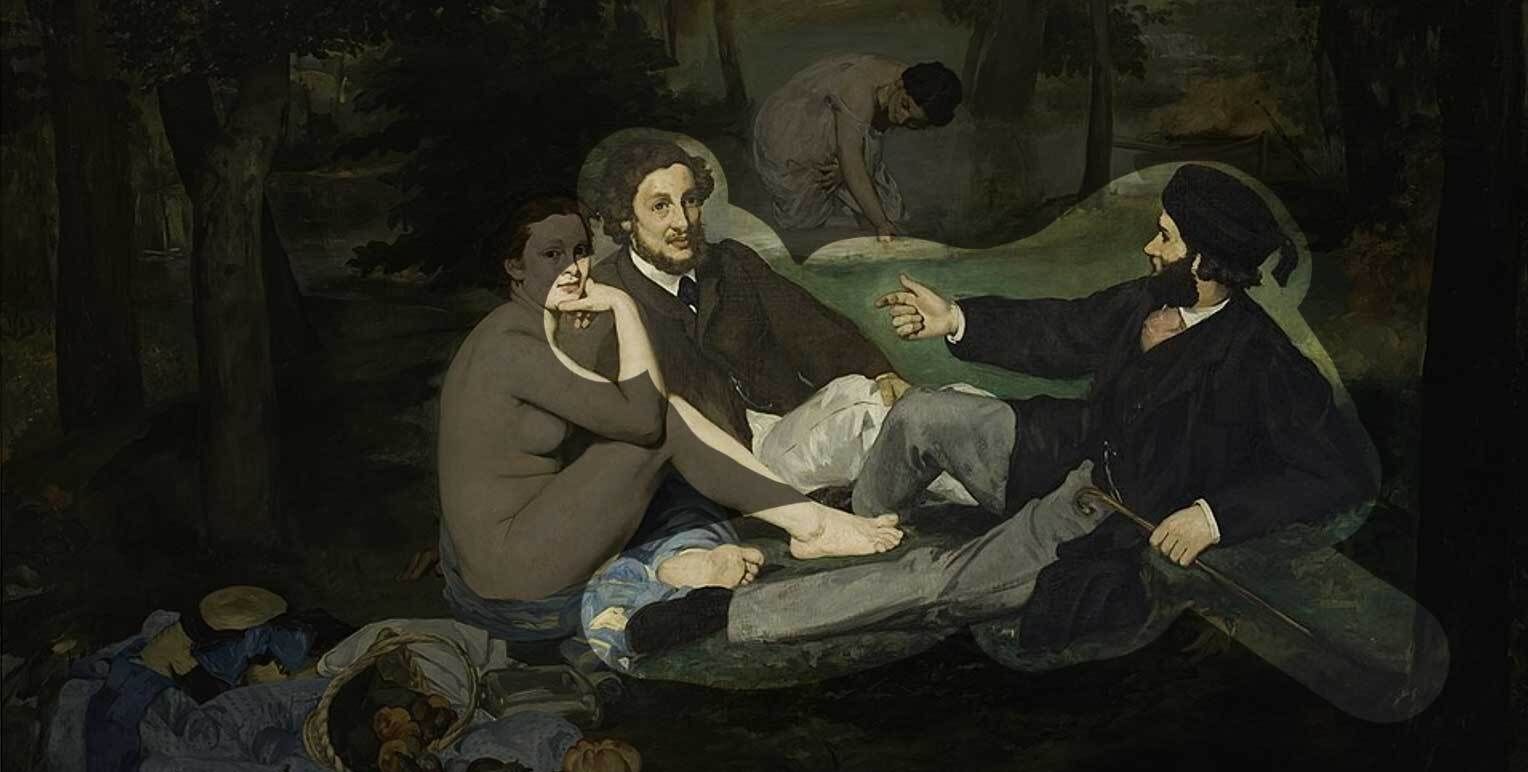
The two men are fully dressed in contemporary clothing of Édouard Manet’s time. They sit casually, absorbed in conversation, seemingly indifferent to the unusual situation beside them. They do not look at the naked woman, and they do not look at us. Their presence anchors the scene in the present, stripping it of any mythological or allegorical excuse. It feels like something happening here and now.
The two women (marked red)
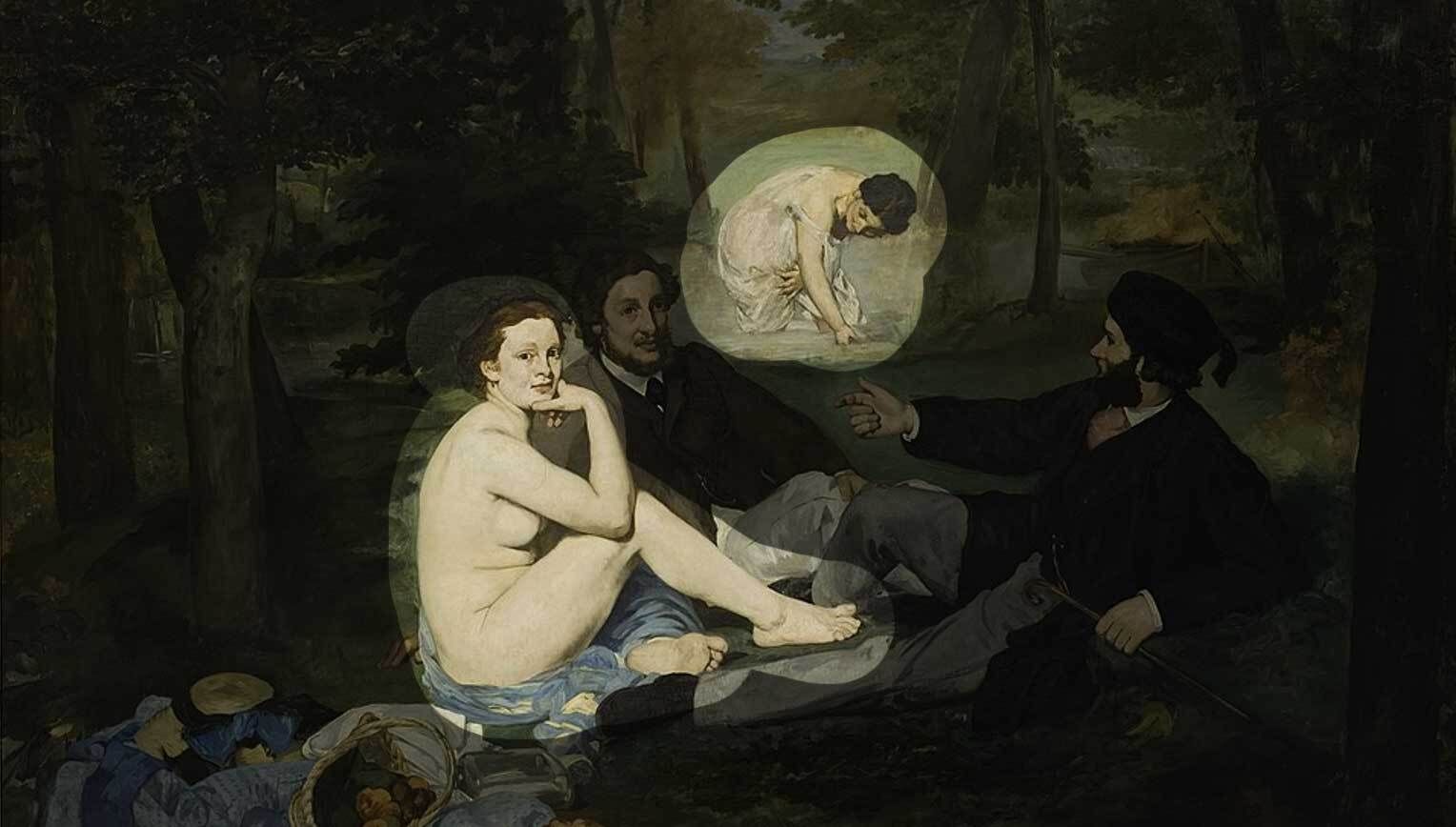
The naked woman in the foreground sits upright and looks directly out at the viewer. Her body is not idealized, and her gaze is neither shy nor apologetic.
Behind her, partially submerged in water, appears a second woman, oddly scaled, almost too large for the depth of the space. She seems detached from the logic of the scene, hovering between presence and distance.
Together, the two women create tension: one fully present, aware, and confronting; the other unstable, slipping into a space where perspective and realism begin to collapse.
The Sentence (marked green)
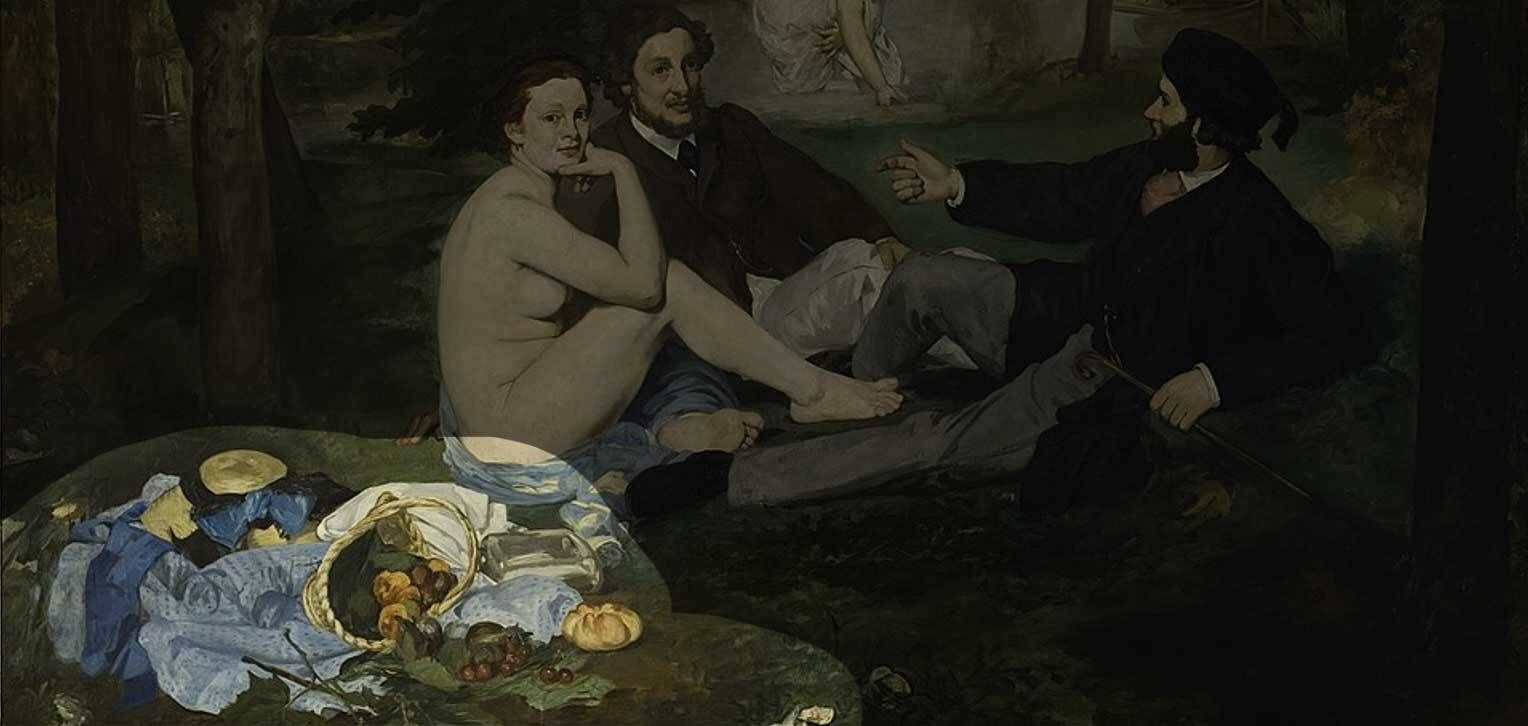
In the foreground lie scattered picnic items: clothes, a basket, fruit, bread. They are not neatly arranged, but spread out in a casual, almost careless way, suggesting a certain indifference, even a quiet sense of disregard.
The picnic sits extremely close to the front edge of the canvas. So close that it feels as if the viewer is not merely observing the scene, but physically present — seated on the grass, sharing the space, almost part of the picnic itself.
Behind the figures rises a dense, dark forest that encloses the scene. Nature here is not idealized or welcoming; it feels heavy, enclosing, and slightly unsettling. Together, the careless picnic and the pressing forest collapse the distance between viewer and image. There is no safe place to stand outside the scene.
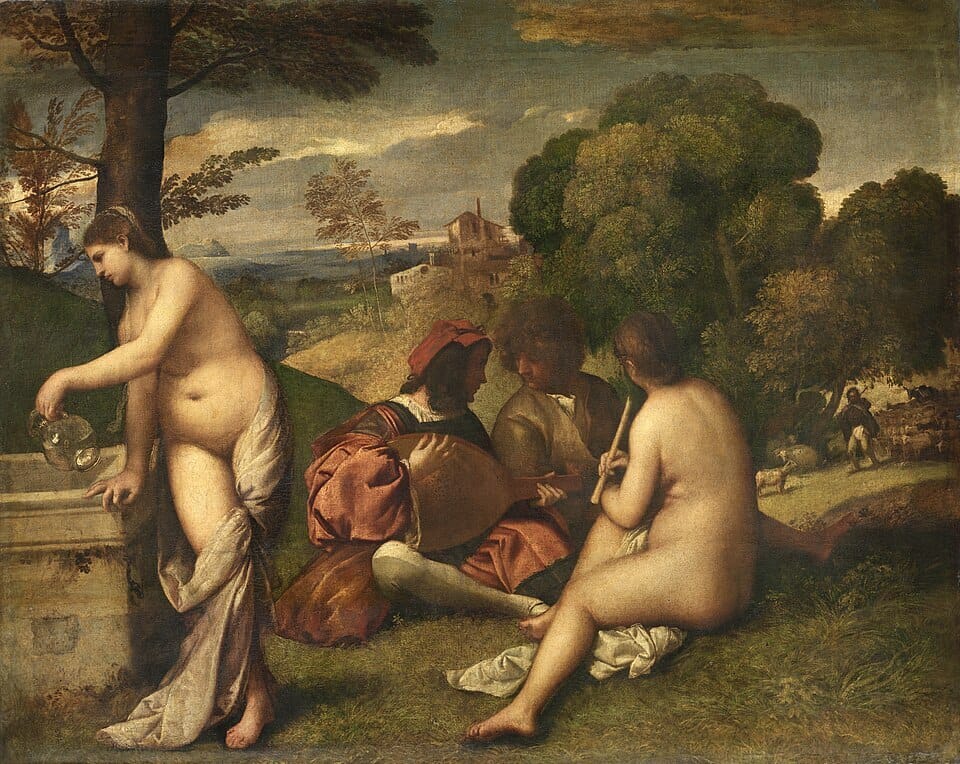 Le Concert champêtre, by Titian - By Giorgione and/or his disciple Titian (who probably finished the painting after Giorgione's death in 1510). - Retouched from File:Le Concert champêtre, by Titian, from C2RMF.jpg, originally C2RMF: Galerie de tableaux en très haute définition: image page, Public Domain, https://commons.wikimedia.org/w/index.php?curid=15710656 The composition closely echoes a Renaissance pastoral scene by Titian, where nude women and clothed men appear together in nature. But while Titian’s figures are protected by allegory and mythology, Manet removes that protective layer entirely. | Fun FactWhen Le Déjeuner sur l’herbe was first shown in 1863, it was not allowed into the official Paris Salon. Instead, it was displayed at the newly created Salon des Refusés - an exhibition for works considered unacceptable by the art establishment. The reaction was explosive. Visitors laughed, mocked the painting, and accused it of being vulgar, immoral, and technically incompetent. Critics were not primarily scandalized by nudity, nudity was common in academic painting, but by context. The problem was that:
To many viewers, it felt less like art and more like an uncomfortable social situation they had accidentally walked into. |
Think About It
With Le Déjeuner sur l’herbe, something quietly radical begins to happen — a shift that will crystallize just a few years later in Olympia. The viewer is no longer invited to simply enjoy nudity, or to settle into a familiar mythological or religious story.
Instead, we are asked to think.
The painting demands that the viewer become an intellectual participant: to question why this image exists, what it is doing, and what position it places us in. This marks the beginning of a profound transformation in art. The two-dimensional image can no longer justify itself by producing a convincing illusion of reality, safely wrapped in a well-known narrative. From this point on, painting begins to insist on something deeper - philosophical, intellectual, critical.
What Manet exposes here is not just a scene on the grass, but the moment when art starts asking the viewer for more than passive pleasure. It asks for thought.
How does it relate to the here and now? or What to say during casual conversation to show off your art knowledge?
When Images Lose Their Alibi – “Le Déjeuner sur l’herbe made me think about how uncomfortable we still are with images that don’t come with instructions. We’re fine with nudity, power, or intimacy - as long as there’s a story explaining it. Manet removes the alibi. And suddenly, the viewer has to confront their own expectations instead of hiding behind a narrative.”
From Passive Viewing to Critical Looking – “What’s radical about this painting is that it marks the moment when images stop trying to please and start demanding something from us. It’s not about illusion anymore, it’s about awareness. In a way, it’s the beginning of visual culture as we know it today: images that don’t just show reality, but question how and why we look at it.”
Now have another Look!
Édouard Manet, Le Déjeuner sur l’herbe (1862–63), oil on canvas, 208 × 264.5 cm, Musée d’Orsay, Paris. twELHYoc3ID_VA at Google Cultural Institute maximum zoom level, Public Domain, https://commons.wikimedia.org/w/index.php?curid=21855901
And If You’re Up for More…
In Banks of the Seine, especially near the Louvre or Île de la Cité, sitting on the grass by the river feels surprisingly close to Manet’s world — elegant, casual, public, and slightly performative. You’re never really alone, and that’s kind of the point.
Or head to Parque del Retiro, where people lounge on the grass, talk, flirt, read, and do absolutely nothing productive — all in plain sight. It’s easy to imagine how a simple picnic can turn into a social stage, where being seen is part of the experience.
Until next time,
Did this newsletter make you see Le Déjeuner sur l’herbe differently?
I’d love to hear what stood out to you - reply to this email or drop a comment below. After all, the world is full of strange, unresolved scenes.
Some of them just happen to be painted on canvas.
Yours,
Inbal Z M

Reply